Availability of Gas Turbines Hindered by Manufacturing Bottleneck
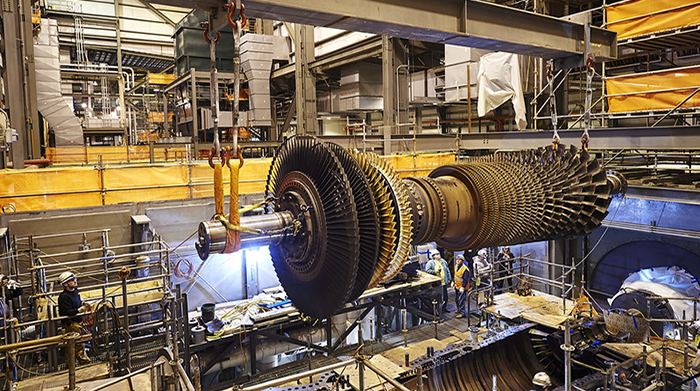
Image courtesy of FirstEnergy under Attribution-NoDerivs 2.0 Generic Deed, resized to 700 x 391 pixels.
Gas turbines are becoming a costly and increasingly difficult-to-secure piece of equipment. A Wood Mackenzie report says the market is struggling to keep pace with a surge in orders, driven largely by rising electricity needs and the rapid expansion of data centers. Let’s take a peek behind the numbers.
State of the Market for Gas Turbines
At the end of 2025, global turbine orders stood at about 110 gigawatts, while manufacturers could produce only 60 to 70 gigawatts’ worth. With demand exceeding available capacity, prices are forecast to reach an eye-popping $600 per kilowatt by the end of 2027, up 195% from 2019 levels. Delivery waits can stretch to six years, and manufacturer order books are reportedly filled through 2027. Yikes!
The implications reach beyond equipment buyers. Gas turbines account for an estimated 20% to 30% of the cost of a combined-cycle power project, and an even larger share for simple-cycle plants. Higher prices and long waits may therefore shape whether projects move ahead, as well as when new generation can come online. Developers are expected to place orders at a peak in 2026 as they seek equipment for 63 gigawatts of planned gas capacity additions between 2026 and 2030.
Data centers are an important part of the demand story. Wood Mackenzie projects their electricity consumption will rise 96% from 2026 to 2031, as AI and cloud services expand. The report points to a proposed 9.2-gigawatt natural-gas facility in Portsmouth, Ohio, as an illustration of the scale of power infrastructure being considered; its initial build-out could require 24 to 30 heavy-duty turbines.
Manufacturers are responding with investments and expanded operations. GE Vernova plans to raise annual large-frame turbine output, Siemens Energy has announced a US$1 billion U.S. investment program, and Mitsubishi Heavy Industries aims to double capacity by 2028. But added factory capacity may not quickly resolve constraints in skilled labor and specialized components. Production of hot-section parts, especially single-crystal turbine blades, is concentrated among a limited number of suppliers.
The result is a market where access to equipment, not just fuel costs, is becoming central to project planning. Even as manufacturers expand, persistent supply-chain bottlenecks could keep the price tag of gas turbines elevated well into the next decade.